
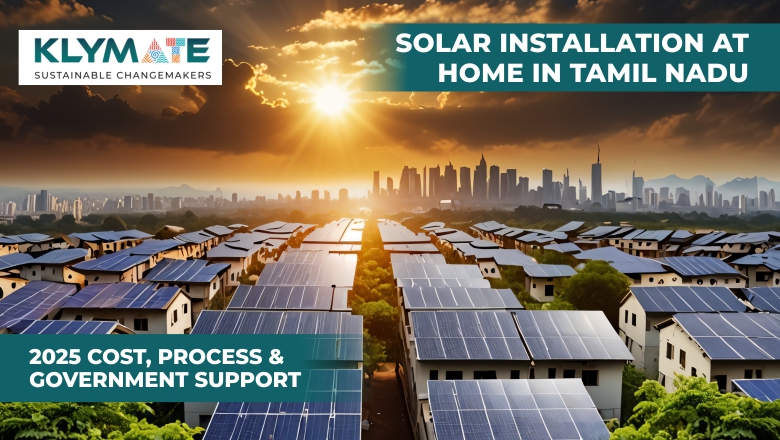
Introduction
Tamil Nadu has always led India’s clean energy movement, and 2025 will be no different. As electricity costs rise and more people focus on sustainability, many homeowners are adopting rooftop solar systems as a wise, eco-friendly choice.
Whether you want to reduce electricity expenses or live a greener lifestyle, installing solar panels is now easier and more affordable than before. This guide will cover everything you need to know, including the cost of rooftop solar systems in Tamil Nadu, the Tamil Nadu solar subsidy for 2025, the installation process, types of solar panels, and the potential solar energy savings in Tamil Nadu.
Understanding Rooftop Solar Systems in Tamil Nadu
A rooftop solar system converts sunlight into usable electricity using photovoltaic (PV) panels on your roof. With Tamil Nadu’s sunny climate and average solar radiation of about 5.5 kWh per day, the state is one of the best in India for harnessing solar power.
There are two main types of systems:
On-grid systems: These connect directly to the Tamil Nadu Electricity Board (TNEB) and allow you to export surplus power back to the grid.
Off-grid systems: These operate independently using batteries to store extra power for future use.
With growing awareness and government support, switching to solar power is both an environmentally friendly and economical choice.
2025 Cost of Solar Installation at Home
The cost of rooftop solar systems in Tamil Nadu in 2025 depends on capacity, quality of equipment, and installation type. Typically, a residential solar system costs between ₹45,000 and ₹60,000 per kW before the subsidy. For an average household, a standard 3 kW system may cost between ₹1.35 lakh and ₹1.8 lakh.
However, with the Tamil Nadu solar subsidy for 2025, the effective cost can decrease significantly. The government provides financial help under the National Rooftop Solar Programme, which lowers your investment and increases your long-term solar energy savings in Tamil Nadu.
Tamil Nadu Solar Subsidy 2025: How to Save Big
One of the most appealing aspects of adopting solar power in Tamil Nadu is the solar subsidy program. In 2025, the Tamil Nadu solar subsidy remains available under the Central Financial Assistance (CFA) scheme managed by the Ministry of New and Renewable Energy (MNRE).
Here’s how the subsidy works:
- Up to 40% subsidy for residential systems up to 3 kW capacity
- 20% subsidy for systems between 3 and 10 kW
Steps to Avail the Subsidy:
- Apply through the National Portal for Rooftop Solar (solarrooftop.gov.in).
- Choose a TEDA-registered vendor (Tamil Nadu Energy Development Agency).
- Install your system according to MNRE guidelines.
- Upload proof of installation and apply for the subsidy release.
- Receive the subsidy amount directly to your bank account.
With this support, your total installation cost can decrease by 25 to 40%, making solar energy a budget-friendly option for most households.
How to Install Solar Panels at Home
If you want to know how to install solar panels at home, the process is fairly simple. With government-approved vendors, it’s even easier. The complete setup usually takes about 2 to 4 weeks.
Here’s what the process looks like:
- Site Survey: The installer checks your rooftop’s structure, direction, and shading.
- System Design: They determine the ideal capacity (1–10 kW) based on your average power usage.
- Vendor Selection: Pick a TEDA-approved vendor for quality.
- Installation: Mount the solar panels, connect the inverters, and link to your power system.
- Net Metering: Apply to TNEB for a bi-directional meter to monitor both imported and exported electricity.
- Inspection & Activation: Once the distribution company (DISCOM) approves your setup, you’ll start generating power.
By following these steps, homeowners can enjoy a smooth solar installation that meets compliance and performance standards.
Choosing the Right Solar Panel Types in Tamil Nadu
Selecting the right solar panel types in Tamil Nadu is crucial for efficiency and durability. Due to the region’s high temperatures and strong sunlight, panels that can handle heat well and come with longer warranties tend to perform best.
Here are the popular solar panel options for 2025:
- Monocrystalline Panels: These are high-efficiency, have a sleek design, and are excellent for compact rooftops in urban areas.
- Polycrystalline Panels: These are cost-effective with moderate efficiency, ideal for homes with more rooftop space.
- Thin-Film Panels: These are lightweight and flexible and work well on industrial or non-standard rooftops.
For Tamil Nadu’s climate, monocrystalline panels are generally recommended because they provide the best output in intense sunlight.
Conclusion
Switching to solar energy is not just good for the environment; it’s also a smart financial decision for households in Tamil Nadu. With the Tamil Nadu solar subsidy for 2025, competitive rooftop solar system costs, and various solar panel types available, it’s a great time to go solar. By learning how to install solar panels at home and choosing the right system for your needs, you can enjoy years of solar energy savings in Tamil Nadu while helping create a cleaner, greener planet for future generations.
FAQs:
1: How can I avail the Tamil Nadu solar subsidy in 2025?
You can apply through the National Portal for Rooftop Solar and select a TEDA-approved vendor. After successful installation and inspection, the approved subsidy will be transferred directly to your bank account.
2:What are the steps to install solar panels at home in Tamil Nadu?
Survey your rooftop, finalize the system design, choose a government-approved vendor, complete installation, apply for net metering, and wait for DISCOM approval.
3:Which solar panel types are best suited for Tamil Nadu’s climate?
Monocrystalline and Polycrystalline panels work best in Tamil Nadu’s hot and sunny conditions due to their efficiency and durability.
4: Is residential solar installation worth it in 2025?
Absolutely! With government subsidies, lower equipment costs, and high power generation, solar installation ensures long-term savings and energy independence.